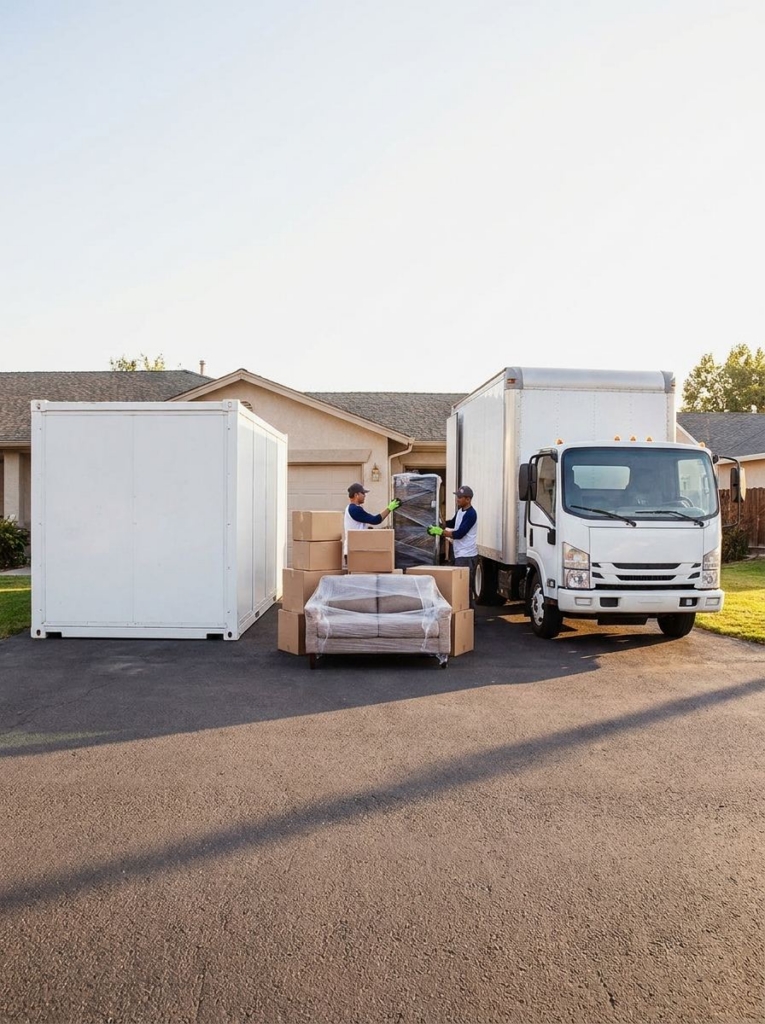
Quick Answer: What PODS Costs in 2026
PODS’ own 2026 cost examples put a studio move at $351 to $893 for a local move and $1,871 to $3,118 for a cross-country move from Detroit to Los Angeles, with the first month of container rental included. Third-party 2026 guides show a wider spread: MoveBuddha’s cost guide runs from $220 for a local move in an 8-foot container to $7,448 for a cross-country move in a 16-foot container, and each extra month of storage adds about $139 to $239, based on PODS’ published averages. None of those figures include loading help, packing supplies, a padlock or contents protection.
For a studio, one-bedroom apartment or partial household, the container quote is only part of the budget. This guide breaks down PODS pricing by container size, distance and storage time, then compares it with a small-load mover, a DIY rental truck and a full-service mover. If you are not sure your shipment counts as a small interstate move, this small move guide can help you size the load before you compare quotes.
PODS Moving Cost in 2026
PODS does not publish a price list. Its moving-cost page says prices depend on the number and size of your containers, the distance, your time frame and the season, and it asks you to request a personalized quote. The ranges below come from PODS’ own 2026 cost examples and from 2026 guides by MoveBuddha, HireAHelper and Forbes Home, which gathered PODS quotes and customer-reported costs.
Each source uses different routes, dates and home sizes, so the numbers do not line up perfectly. Where they disagree, this guide shows each range and names the source. Use them to set a budget, then confirm with a quote for your own ZIP codes and dates.
PODS Cost by Container Size: 8, 12 and 16 Feet
MoveBuddha’s 2026 PODS cost guide (last updated June 24, 2026) lists these ranges by container size:
- 8-foot container: $220 to $426 for a local move of about 50 miles, $450 to $828 for a move of up to 250 miles, and $2,068 to $4,028 for a cross-country move. PODS rates this size for a studio or a room of 500 sq ft or less.
- 12-foot container: $294 to $637 for a local move. PODS rates this size for a one-bedroom home or a space of 500 to 800 sq ft, but it offers the 12-foot container only for local moves and storage.
- 16-foot container: $323 to $813 for a local move, $911 to $2,107 for a move of up to 250 miles, and $5,439 to $7,448 for a cross-country move. PODS rates this size for a two-bedroom home or up to 1,200 sq ft.
The 12-foot limit matters for anyone moving a one-bedroom apartment out of state. PODS’ long-distance moving page lists only the 8-foot and 16-foot containers, so a one-bedroom load has to fit in the small container or move up to the large one. The small container measures 8 by 7 by 8 feet, according to PODS’ storage FAQ, which is likely why some people search for a “7-foot pod.”
PODS Cost by Distance: Local vs. Out of State
- Local, under about 50 miles: PODS’ 2026 cost-of-moving guide shows $351 to $893 for a studio move within Detroit (37 miles) and $467 to $655 for a one-bedroom move within Raleigh (22 miles). HireAHelper’s 2026 container cost database puts local PODS moves at $456 to $783, with an average of $582.
- Regional, around 500 miles: PODS’ guide shows $1,679 to $2,798 for a one-bedroom move from Raleigh to Ocala (562 miles). HireAHelper lists $1,455 to $3,119, with an average of $1,964. MoveBuddha lists $2,401 to $3,842 for 500 miles.
- Long distance, around 1,000 to 1,200 miles: MoveBuddha lists $2,881 to $4,802 for 1,000 miles. HireAHelper lists $2,039 to $4,235, with an average of $2,722, for about 1,200 miles.
- Cross-country, 2,000 miles or more: PODS’ guide shows $1,871 to $3,118 for a studio move from Detroit to Los Angeles (2,252 miles). MoveBuddha lists $2,302 to $3,889 for a one-bedroom cross-country move. HireAHelper puts a move of about 2,500 miles for a 1,500 sq ft home at about $4,856.
Forbes Home’s September 2026 guide adds a wider frame: a small local move with an 8-foot container can cost as little as $300, and many long-distance moves fall between $2,500 and $7,000.
PODS’ own examples come in lower than the third-party ranges on some routes. The PODS figures are estimates from PODS and MoveBuddha for specific routes as of June 2026, while MoveBuddha’s guide and HireAHelper’s database combine quotes with customer-reported costs. If your quote lands inside the overlap, it is in line with the market.
PODS Storage Cost per Month
- PODS’ storage-cost guide: Monthly container rentals average $139 to $239. The 8-foot container averages $139 a month on your property or $189 at a PODS Storage Center, the 12-foot averages $159 or $210, and the 16-foot averages $175 or $239. Delivery and pickup average $80 each way.
- PODS’ storage FAQ: On-site storage starts at $149 a month, with delivery and pickup fees averaging $74.99.
- MoveBuddha: $150 to $359 a month per container, plus $75 to $150 per delivery or pickup trip.
- Forbes Home: Its storage-only quote from PODS came to $380 a month.
PODS’ two pages differ slightly ($139 as an average versus $149 as a starting rate), and both describe national figures. Rates vary by city and by season, and Forbes Home’s $380 quote shows how far above the averages a single quote can land.
What a PODS Quote Includes and What It Leaves Out
A standard PODS moving quote covers delivery of the empty container, transport to your new home, final pickup and one month of container rental. PODS’ storage FAQ says that 30-day rental starts the day the container is delivered and includes time in transit, so loading days and shipping days both come out of the first month.
The quote does not include loading or unloading labor, packing supplies, a padlock, contents protection, parking permits or extra months. MoveBuddha’s sample Atlanta quote, for example, listed a PODS padlock at $34.30. PODS prices by container, not by weight, so heavy furniture does not raise the transport charge. Anything that does not fit, however, means a larger or second container.
What Size PODS Container Do You Need for a Studio or One-Bedroom Move?
Container size is where most small-move budgets shift. For a local move, a one-bedroom apartment often fits PODS’ 12-foot container. For an out-of-state move, that middle size is not available, so the choice is between the 8-foot and the 16-foot.
That decision matters because you pay for the whole container, not the space your belongings take up. A compact studio can fill an 8-foot container well. A one-bedroom with a queen bed, sofa, dresser, dining set, desk and boxes may overflow it, and moving the same load in a 16-foot container can mean paying to ship empty space.
When an 8-Foot Container May Be Enough
An 8-foot container works best when the move looks more like a studio than a full apartment: a bed, a small sofa, a compact dresser, a small table and several boxes. It helps when furniture comes apart, boxes are uniform, and the person loading knows how to stack and brace items for a long trip.
The risk is underestimating volume. Cushions, lamps, chairs, awkward furniture and fragile items you cannot stack tightly eat space fast. If you are close to the limit, ask PODS how upgrades work before moving day, not after the container arrives.
When You’re Paying for Empty Space
A container gets expensive for a small load when you only need to move selected items: a sectional, a bedroom set, a few framed pieces, a desk, or boxes from a dorm or a downsizing project. On MoveBuddha’s cross-country ranges, the 16-foot container starts at a higher price ($5,439) than the 8-foot container tops out ($4,028), whether or not you fill it.
For these loads, a small-load mover usually makes more sense, because the price follows what you ship rather than the size of the box you rent.
PODS vs. Small-Load Movers: Which Costs Less for a Studio or 1BR?
The option that costs less depends on the total, not the sticker price. PODS can come out ahead when you have enough belongings to fill most of a container, can pack and load safely, and want several days to load. It also helps when you need storage between move-out and move-in.
Small-load movers price differently. Instead of renting you a whole container, they typically price by weight or volume, item type, distance and service level, often with a shipment minimum. For a deeper look at minimums and partial-load pricing, see this guide to partial move costs and options.
A small-load mover tends to cost less when you are moving a few large furniture pieces, fragile items, part of an apartment, or a load that needs labor at both ends. A door-to-door small move service can include pickup, packing, transport and delivery in one quote, which makes it easier to compare against a container quote plus hired labor.
- PODS moving container: Best for a near-full studio or 1BR, flexible loading and a gap between move-out and move-in; usually included: container delivery, transport, final pickup and one month of rental; extra costs: loading labor, packing supplies, padlock, extra months, permits and contents protection; risk for small loads: paying for unused space, especially when an out-of-state 1BR needs the 16-foot container.
- Small-load mover: Best for furniture, partial apartment contents, fragile pieces and downsizing; usually included: pickup, loading, transport and delivery, often with professional packing; extra costs: crating, stairs, long carries, special handling and added protection; risk for small loads: shipment minimums can matter for a very small load.
- DIY rental truck or trailer: Best for budget moves with able drivers and helpers; usually included: the vehicle for a set rental period; extra costs: fuel, tolls, lodging, insurance, equipment and parking; risk for small loads: the savings shrink over long distances once fuel, hotels and time are counted.
- Full-service mover: Best for larger households or hands-off moves; usually included: loading, transport, unloading and basic furniture protection; extra costs: packing, materials, valuation, storage and access fees; risk for small loads: minimum charges can be high for a studio or partial load.
PODS Sticker Price vs. Real Total Move Budget
A container quote covers the container and its trips. Your real budget also has to cover labor, time, access and risk, and that is where small-move costs change after the first quote.
Labor Costs
PODS containers are built around customer loading. PODS can refer you to local packing and loading services, and HireAHelper notes that moving labor is not part of the standard PODS price. If you hire crews at both ends, the total starts to approach what a small-load mover charges with loading included.
Friends with time, strength and the right equipment can save you money. A fourth-floor walk-up, a heavy dresser, a sleeper sofa or fragile furniture is where professional help prevents injuries and damage.
Storage and Timing
Containers are useful when move-out and move-in dates do not line up. You can load, store the container and schedule final delivery later. That flexibility is the strongest reason to choose one.
The tradeoff is monthly billing. HireAHelper notes that PODS does not prorate, so keeping the container even slightly past your billing date adds a full month, at $139 to $239 on PODS’ average rates. If a closing date slips or an elevator reservation falls through, ask when the next billing period starts and whether redelivery fees apply.
Apartment Access and Permit Fees
Apartments and city addresses complicate container moves. Limited parking, HOA rules, loading dock windows, elevator reservations and street placement restrictions all affect cost and feasibility. MoveBuddha says street placement permits commonly run $30 to $100 per day, depending on the city. HireAHelper notes that PODS may charge up to $150 when a driver cannot complete a service because the container is blocked or not ready, and up to $150 for cancellations after the cutoff.
Before choosing a container, confirm that it can legally sit at both addresses. Some buildings do not allow portable containers at all. If the container cannot sit close to your door, labor costs rise quickly.
Contents Protection
Forbes Home and HireAHelper both report PODS Contents Protection at $38.95 a month for $5,000 of coverage, up to $516.95 a month for $300,000. HireAHelper adds a $100 deductible per claim and a one-time $54.95 coverage fee on long-distance moves. Container protection is not the same as a mover’s valuation or shipping insurance, so compare what each option covers, what it excludes, and what you need to file a claim.
Most Affordable Ways to Move a Small Load Out of State
The most affordable way to move a small load out of state depends on what you are moving. Boxes behave differently than furniture, and fragile items behave differently than dorm supplies. A method that works for a stack of boxes may be a poor fit for a walnut dresser, art or a glass-front cabinet.
Common options include a cargo van, rental truck, trailer, portable container, parcel shipping for boxes, freight and specialty furniture shipping. The best answer is often a mix. For a walkthrough of the options, see how to ship household items to another state.
A DIY rental truck looks inexpensive until you add the one-way fee, fuel, tolls, hotels, meals, insurance, equipment and your time. It can still be the right choice over a manageable distance with reliable helpers. For furniture-specific strategies, compare these money-saving ways to ship furniture out of state.
- Boxes only: Compare parcel shipping, freight options and checked baggage if you are flying.
- Boxes plus one or two furniture pieces: Compare box shipping plus small-load furniture shipping.
- Full studio or 1BR: Compare a container, a rental truck, a small-load mover and a full-service mover.
- Fragile or high-value furniture: Compare small-load movers that offer packing, crating or blanket wrap.
- Need storage: Compare container storage, mover storage, and a short-term storage unit plus delivery.
When a Small-Load Mover Is Worth More Than a Container
A lower container quote is not always the lower-risk choice. With a container, you pack, load, brace and secure everything yourself. On an interstate trip, the load goes through vibration, turns, braking and handling at more than one point. If furniture shifts or boxes crush, the savings disappear.
PODS itself recommends against putting heirlooms, irreplaceable artifacts, artwork and other high-value items in its containers. Antiques, valuable furniture, art, estate pieces and small office equipment are exactly where professional packing, crating and an inventory justify a higher quote. If that describes your shipment, compare the cost to ship antiques or valuable furniture before you book a container.
Physical work matters too. Stairs, heavy lifting, disassembly, reassembly and finding reliable help in two cities are harder than they look on a quote. If you do not have that help, a door-to-door small-load service is often worth the difference.
How Ship Smart Prices a Small Move
Ship Smart has arranged small long-distance moves since 1999 and focuses on loads under 2,000 lb: too big for a parcel carrier and too small for a conventional mover. Here is how its process compares with a container:
- Estimate first, any time: The online Small Move Cost Calculator gives an estimate 24/7 from your route, access and inventory, and a Ship Smart expert reviews it within 12 to 24 hours.
- Packing is part of the service: Ship Smart picks up your items and packs them professionally at its warehouse, so you do not have to brace furniture inside a container yourself.
- You pay for actual weight: Ship Smart weighs the packed shipment and bases the final price on that actual weight, not on the size of a container. There is no deposit; you pay once your shipment has been packed and weighed.
- Access costs are known upfront: Stairs cost $100 per flight, and elevator access is a flat $100.
- Plan for transit time: Most domestic shipments take 2 to 3 weeks. If timing is tight, ask about expedited service with a guaranteed delivery date.
Ship Smart’s small move service also lets you choose curbside delivery to keep costs down or inside delivery at the destination.
PODS Moving Cost FAQ
What Is the Average Cost of PODS?
There is no single national average, because distance changes the price more than anything else. HireAHelper’s 2026 data puts the average PODS move at $582 locally, $1,964 for about 500 miles, $2,722 for about 1,200 miles, and about $4,856 for a 2,500-mile move of a 1,500 sq ft home. PODS’ own studio examples run $351 to $893 locally and $1,871 to $3,118 cross-country.
How Much Does a PODS Container Cost per Month?
PODS’ published averages put monthly container rental at $139 to $239, depending on container size and whether it stays on your property or at a PODS Storage Center. A moving quote includes the first month, and PODS bills each month after that in full. MoveBuddha reports a wider range of $150 to $359 a month, depending on region and container size.
How Much Do 8-Foot, 12-Foot and 16-Foot PODS Cost?
For a local move, MoveBuddha lists $220 to $426 for an 8-foot container, $294 to $637 for a 12-foot and $323 to $813 for a 16-foot. Cross-country, it lists $2,068 to $4,028 for an 8-foot and $5,439 to $7,448 for a 16-foot. PODS offers the 12-foot container only for local moves and storage. For storage on your property, PODS lists monthly averages of $139 for the 8-foot, $159 for the 12-foot and $175 for the 16-foot.
Is It Cheaper to Use PODS or a U-Haul?
A DIY rental truck usually costs less upfront. HireAHelper’s 2026 averages put a rental truck at $113 versus $582 for PODS on a local move, $671 versus $1,964 for about 500 miles, and about $3,250 versus about $4,856 cross-country, before fuel, hotels and meals for the truck. PODS’ own studio example from Detroit to Los Angeles shows a closer gap: $1,667 to $2,973 for a rental truck plus fuel, versus $1,871 to $3,118 for PODS. If you mean U-Haul’s U-Box containers, HireAHelper found U-Box generally a little less expensive than PODS in its 2026 customer data.
Are PODS Expensive?
PODS sits in the middle. PODS’ own 2026 guide calls a container the middle-cost option between a rental truck and a full-service mover, and MoveBuddha reports that moving containers cost about 30% less than full-service movers on average. For a small load, the real question is how much of the container you fill. A half-empty 16-foot container going out of state is an expensive way to move a few pieces of furniture.
How Many PODS Do I Need for a 2,000 Square Foot House?
PODS recommends two 16-foot containers for a 2,000 sq ft house. That is a full household, well beyond a small move, so compare a full-service mover or multiple containers. If you are moving only part of that house, such as a few rooms of furniture, price a small-load mover as well.
Bottom Line: Which Option Should You Choose?
There is no universal winner in the PODS vs. small-load mover debate. Load size, labor, access, timing and risk decide it.
- Choose a PODS container if you have a near-full studio or 1BR, need flexible storage, can pack and load safely, and can legally place the container at both addresses. It is a strong value when you fill most of it.
- Choose a small-load mover if you have less than a full apartment, want packing and loading included, are moving furniture or valuable items, or do not want to pay for container space you will not use.
- Choose a rental truck if you can load and drive, the distance is manageable, and fuel, lodging and time do not erase the savings.
- Choose a full-service mover if you are moving a larger household and want a hands-off move.
Before booking, compare quotes line by line: container size or shipment minimum, transit time, included storage days, labor, packing materials, permits, protection terms, access fees and final delivery terms. To see what your small move would cost, get an instant estimate from the Small Move Cost Calculator.